Cash stuffing for beginners: how the envelope method works
How cash stuffing works, which spending to put in envelopes, how much to stuff each payday, and what to do when an envelope runs out early.
Cash stuffing is the envelope method with a new name. On payday you take out cash for the spending that tends to get away from you, split it into labeled envelopes, and spend only from the envelope. When the groceries envelope is empty, grocery shopping is done until the next payday.
It sounds old-fashioned, and that's the point. A card makes every purchase feel the same size. Counting out real notes doesn't. This guide covers how cash stuffing works for beginners, what to put in envelopes, how much, and how to keep it going past the first month.
How cash stuffing works
The whole method fits in four steps:
- Pick your categories. These are the kinds of spending that change from week to week, like groceries or eating out.
- Decide an amount for each one, per paycheck.
- On payday, withdraw that total in cash and split it into envelopes.
- Spend only from the envelope. When it's empty, you stop, or you move money in from another envelope on purpose.
Your fixed bills, like rent, insurance and loan payments, stay in the bank and get paid the way they always have. Cash stuffing is for the spending in between, which is usually where a budget leaks.
Which spending to put in envelopes
Choose categories where you decide how much to spend each time you buy. Good first envelopes:
- Groceries
- Fuel or transport
- Eating out and takeout
- Personal care: haircuts, toiletries, makeup
- Fun money: yours to spend on anything, no explanation needed
Leave out anything that's paid automatically or online-only. A streaming subscription doesn't belong in an envelope. Neither does a bill that's the same every month.
Start with three to five envelopes. Twelve envelopes in week one is how people quit in week three. You can add more once the first few feel normal.
How much to stuff each payday
Look back through your last two or three months of bank statements and add up what you actually spent in each category. Not what you wish you'd spent. Divide by the number of paychecks in that time to get a per-paycheck figure, then round it to an amount that's easy to withdraw.
A made-up example, for someone paid every two weeks:
| Envelope | Per paycheck |
|---|---|
| Groceries | $200 |
| Fuel | $80 |
| Eating out | $40 |
| Personal care | $30 |
| Fun money | $50 |
| Total to withdraw | $400 |
So every other payday, this person takes out $400 and splits it five ways. Everything else in the paycheck goes to bills and savings in the bank, the same as before.
If your numbers from the statements feel too high, don't cut them all in half on day one. Lower one envelope a little, see if it holds for a month, then lower another. A budget you can live with beats a strict one you abandon.
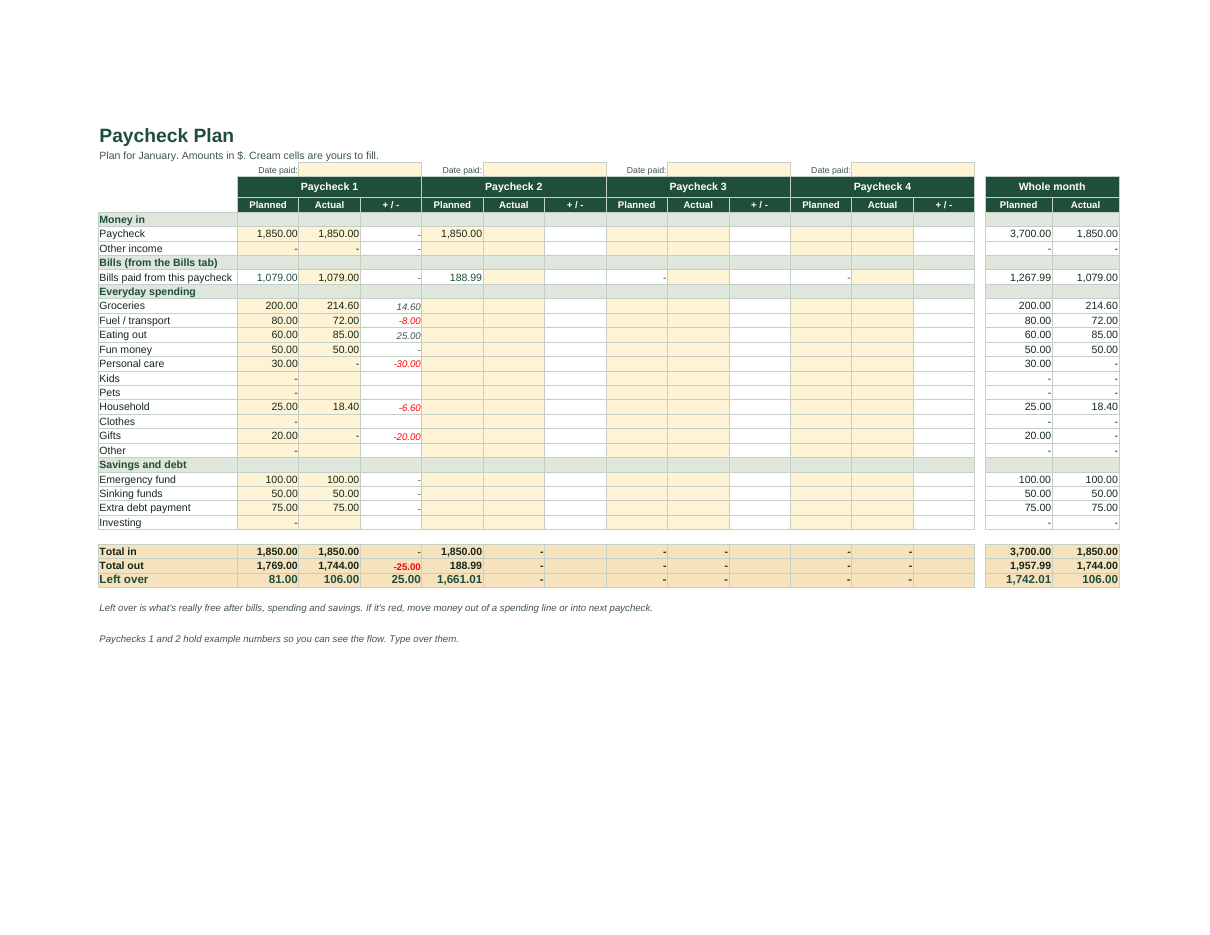
If you're not sure which bills each paycheck already has to cover, sort that out first. Our guide to budgeting by paycheck shows how to assign each bill to a payday, so you know how much cash is safe to take out.
Track every envelope, not just the cash
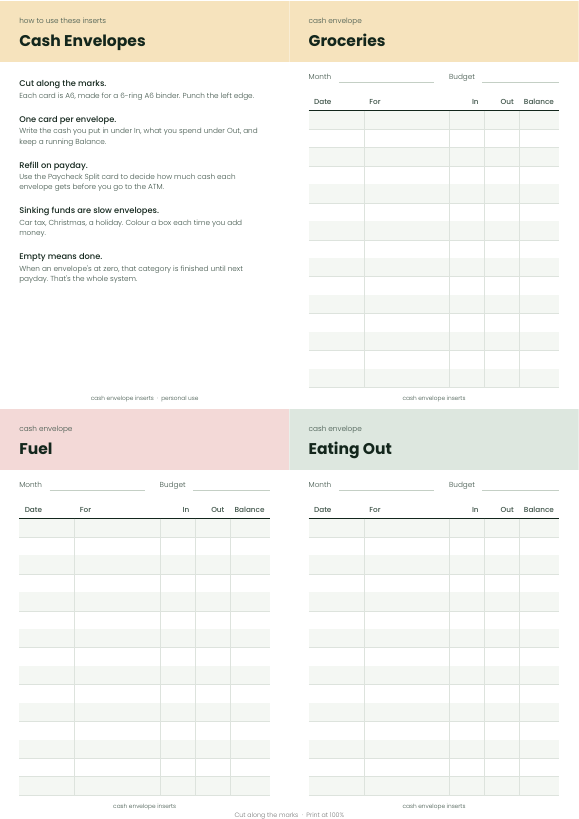
The envelopes hold the money. A tracker card tells you what happened to it. Each time you take money out, write the date, what it was for and the new balance. It takes ten seconds at the checkout or when you get home.
This matters more than it sounds. Without a record, an empty envelope only tells you the money is gone. With one, you can see that a third of the eating-out money went on weekday coffees, and decide whether that's what you want.
At the end of each pay period, look at every envelope's card and ask: was this amount right? Too much, too little, or about right? Adjust the next payday's amount by a small step.
When an envelope runs out early
It will happen, usually in the first month. You have three honest options:
- Wait. If it's eating out or fun money, the simplest answer is to go without until payday.
- Borrow from another envelope, on purpose. Move $20 from fun money to groceries and write it on both cards. You've made a choice, not broken the system.
- Raise the amount next time. If groceries runs out every single paycheck, your estimate is too low, not your willpower. Fix the number.
The one thing to avoid is quietly paying with a card and pretending it didn't happen. That's the habit cash stuffing is meant to replace.
What to do with leftover cash
If there's money left in an envelope on payday, you can roll it over to the same envelope, move it to fun money, or put it toward savings. Many people move leftovers into a sinking fund for a cost they know is coming, such as car repairs or December. Our guide to sinking funds explains how to set those up and how much to put in each.
Rolling over is fine for groceries, which naturally swing up and down. For eating out, rolling over can turn into one big blowout at the end of the month, so decide in advance which envelopes roll and which don't.
Keeping cash safe
Cash stuffing works best with modest amounts. A few practical rules:
- Carry only the envelopes you'll need that day. Leave the rest at home somewhere sensible.
- Keep larger savings in the bank, not in envelopes. Use a tracker to show the balance instead.
- If your bank charges for cash withdrawals, check the fees and plan one withdrawal per payday rather than several small ones.
Cash isn't protected the way a bank account usually is. If it's lost or stolen, it's gone, so keep the amount you hold to what you need for one pay period.
Common questions
How do I start cash stuffing with little money?
Start with one or two envelopes for the categories that slip most, often groceries and eating out, and stuff only those. Even one envelope shows you where the money goes. Add more envelopes as your budget allows.
Does cash stuffing actually help you save money?
It can, because spending physical cash and watching an envelope empty makes it easier to notice and stop. It doesn't save anything on its own, though. The amounts you choose and the habit of tracking each envelope are what make the difference.
Can I do cash stuffing without using real cash?
Yes. Some people keep the same envelopes as separate bank pots or a tracker page and pay by card, recording each purchase against its envelope. You lose some of the feel of handing over notes, but the system of fixed amounts per category works the same way.
This guide is general information, not personal financial advice. Your numbers and circumstances are your own.