How to budget by paycheck when the month doesn't fit
A step-by-step way to budget by paycheck instead of by month, so every payday has a plan and your bills are covered before the money lands.
A monthly budget assumes your money arrives once, on the first, in one tidy lump. Most paychecks don't work like that. You're paid every week or every two weeks, rent is due on the 1st, the car payment on the 14th, and the phone bill whenever it feels like it. The month isn't the problem. The mismatch is.
Budgeting by paycheck fixes the mismatch. Instead of one plan for the month, each payday gets its own small plan: what this money has to cover before the next one arrives.
Why a monthly budget keeps breaking
A monthly budget tells you that you can afford your bills in total. It doesn't tell you whether the money will be there on the day each bill is due.
That gap is where the stress lives. You can earn enough for the month and still come up short on the 28th, because rent is due before the next paycheck clears. So you move money around, pay something late, or put groceries on a card. Then you spend the next paycheck catching up, and the cycle starts again.
A paycheck budget asks a narrower question: what does this paycheck need to pay for? That question has an answer you can check with a calendar.
Step 1: List your paydays and your due dates
Open a calendar for the next two months. Mark:
- Every payday, with the amount you actually take home (after tax and deductions).
- Every bill, on the day it leaves your account, with the amount.
Include the dull ones: subscriptions, insurance, minimum payments on debts, childcare. If a bill changes month to month, use the highest amount from the last three months. It's better to be pleasantly surprised.
If your income changes from week to week, write down the lowest paycheck you'd realistically get, and plan with that.
Step 2: Give each bill to a paycheck
Now match them up. Each bill belongs to the last paycheck that arrives before its due date.
Say you're paid on the 5th and the 19th:
| Paycheck | Covers bills due |
|---|---|
| 5th | 6th to the 19th |
| 19th | 20th to the 5th of next month |
Rent due on the 1st belongs to the paycheck on the 19th, not the one on the 5th. That's the detail a monthly budget hides, and it's usually the reason one paycheck feels impossible while the other feels roomy.
Step 3: Plan what's left, in order
Once the bills are assigned, take each paycheck and subtract in this order:
- Bills assigned to it.
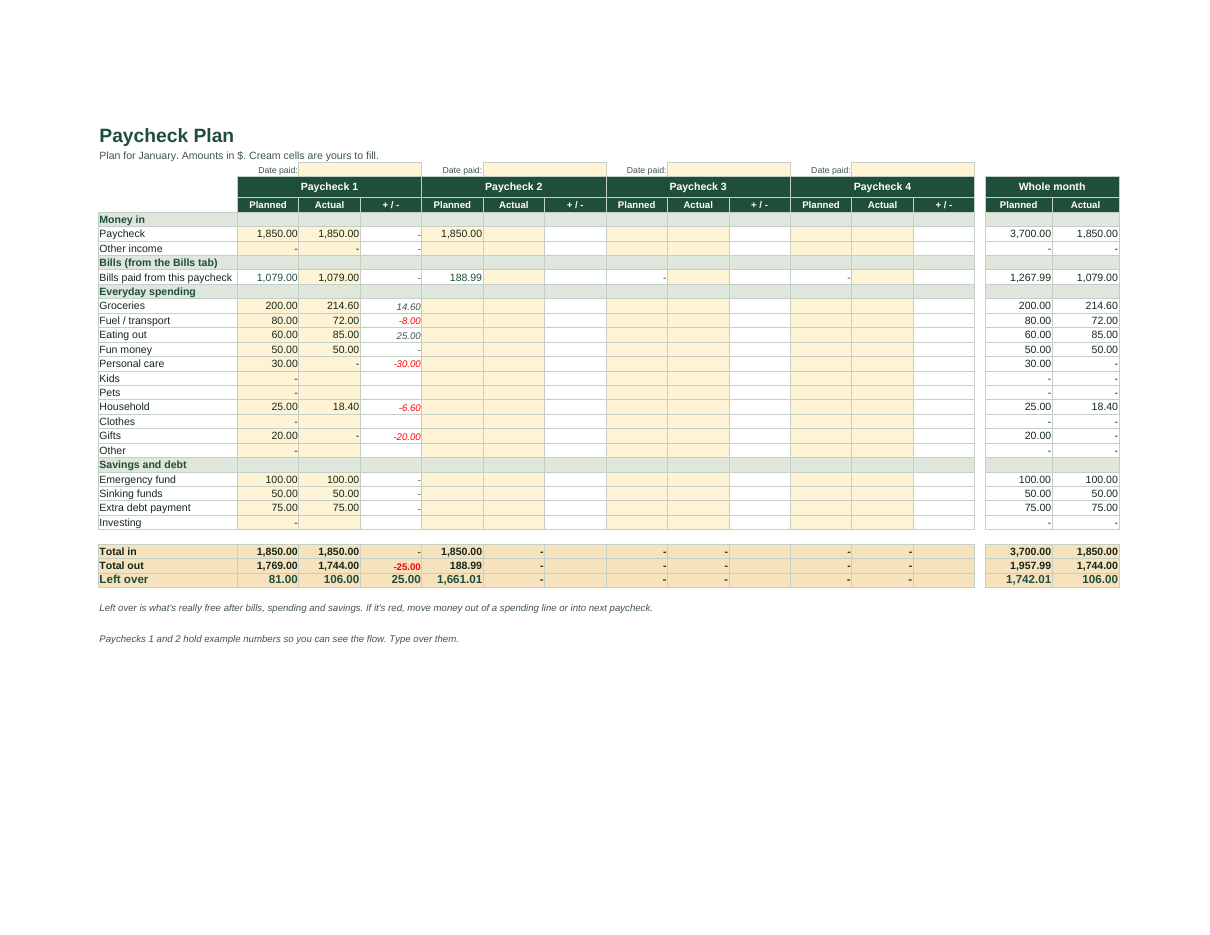
- Everyday spending until the next payday: groceries, fuel, transport. Work it out per day and multiply by the days in the gap. Fourteen days of groceries is a different number from "a month, roughly."
- Savings and extra debt payments. Even a small, fixed amount counts. Treat it like a bill.
- What's genuinely left. This is yours, guilt-free.
If a paycheck goes negative at step 1 or 2, you've found the problem while there's still time to do something about it. That's the whole point.
Step 4: Fix the lopsided paycheck
Almost everyone finds that one paycheck carries far more than the other, usually the one before rent. You have three ways to even it out:
- Move a due date. Many lenders, utilities and card companies will change your payment date if you ask. Moving one or two mid-size bills to the lighter paycheck can be enough.
- Set money aside from the lighter paycheck. If rent takes most of paycheck two, hold back part of it from paycheck one. Put it in a separate account or pot so it doesn't get spent.
- Split the big bill yourself. Nothing stops you from transferring half the rent into a holding account each payday.
None of these change how much you earn or owe. They change the timing, and timing is what a paycheck budget is about.
What about months with an extra paycheck?
If you're paid every two weeks, you get 26 paychecks a year, not 24. Two months a year have three paydays. If you're paid weekly, four months a year have five.
Your regular bills are already covered by the usual paychecks, so decide in advance where the extra one goes. Good options, in rough order: catching up anything that's behind, building a one-month buffer so you're no longer living payday to payday, then a sinking fund for a known cost like car repairs or the holidays. Our guide to sinking funds shows how to set those up.
Paper or spreadsheet?
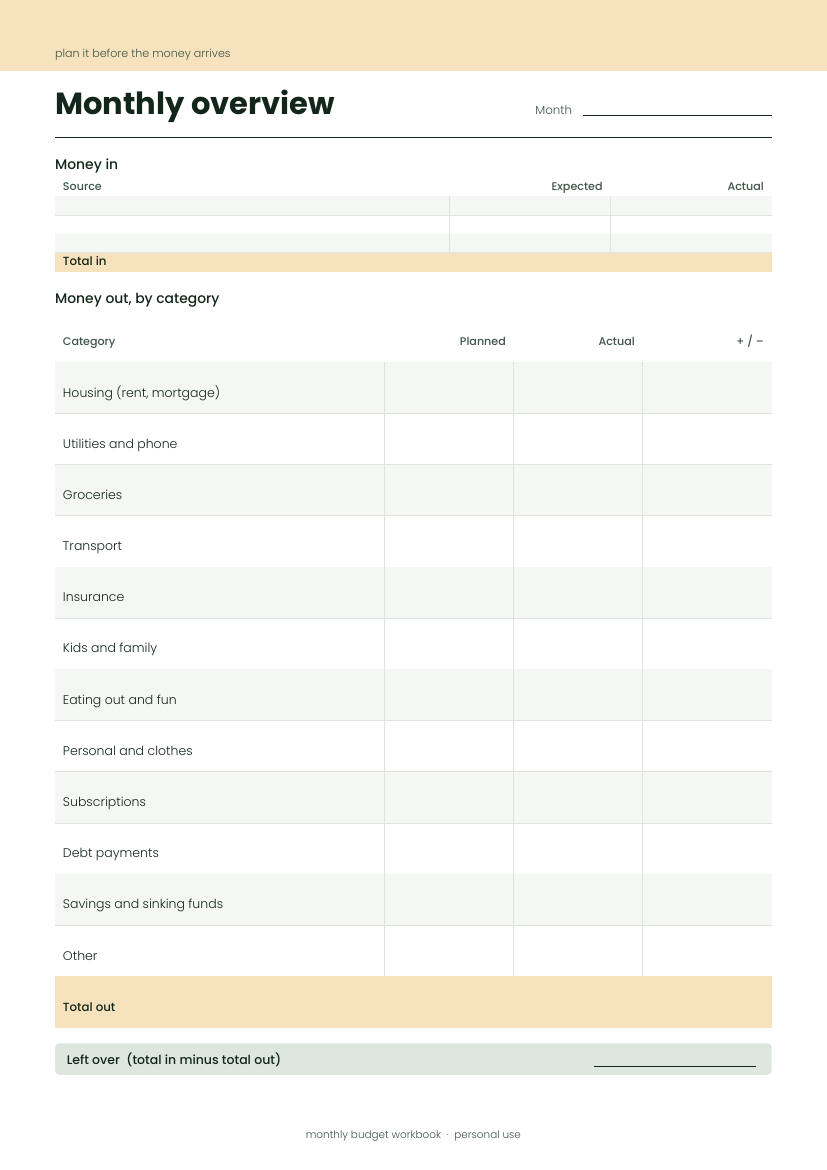
Either works. What matters is that you can see each paycheck and its bills on one page.
A spreadsheet does the subtraction for you and is easy to adjust when a bill changes. Paper is slower but many people find that writing the numbers by hand makes them stick. If your paydays line up neatly with the calendar month (one salary on the same date each month), a simple monthly plan may be all you need.
Common questions
Is budgeting by paycheck better than a monthly budget?
It's better when you're paid weekly, every two weeks or irregularly, or when your bills are due before the paycheck that's meant to cover them. If you're paid once a month on a fixed date, a monthly budget does the same job with less effort.
How do I budget by paycheck when I'm paid every two weeks?
Mark each payday on a calendar, assign every bill to the last paycheck that lands before its due date, then plan everyday spending for the 14 days until the next one. Decide ahead of time what the two extra paychecks a year are for.
What if one paycheck can't cover the bills assigned to it?
Ask to move a due date, hold back money from the lighter paycheck, or split a large bill across two paydays. If the total of your bills is more than the total of your income, the timing isn't the issue and the plan needs a cut or more income.
This guide is general information, not personal financial advice. Your numbers and circumstances are your own.