How to budget for maternity leave, step by step
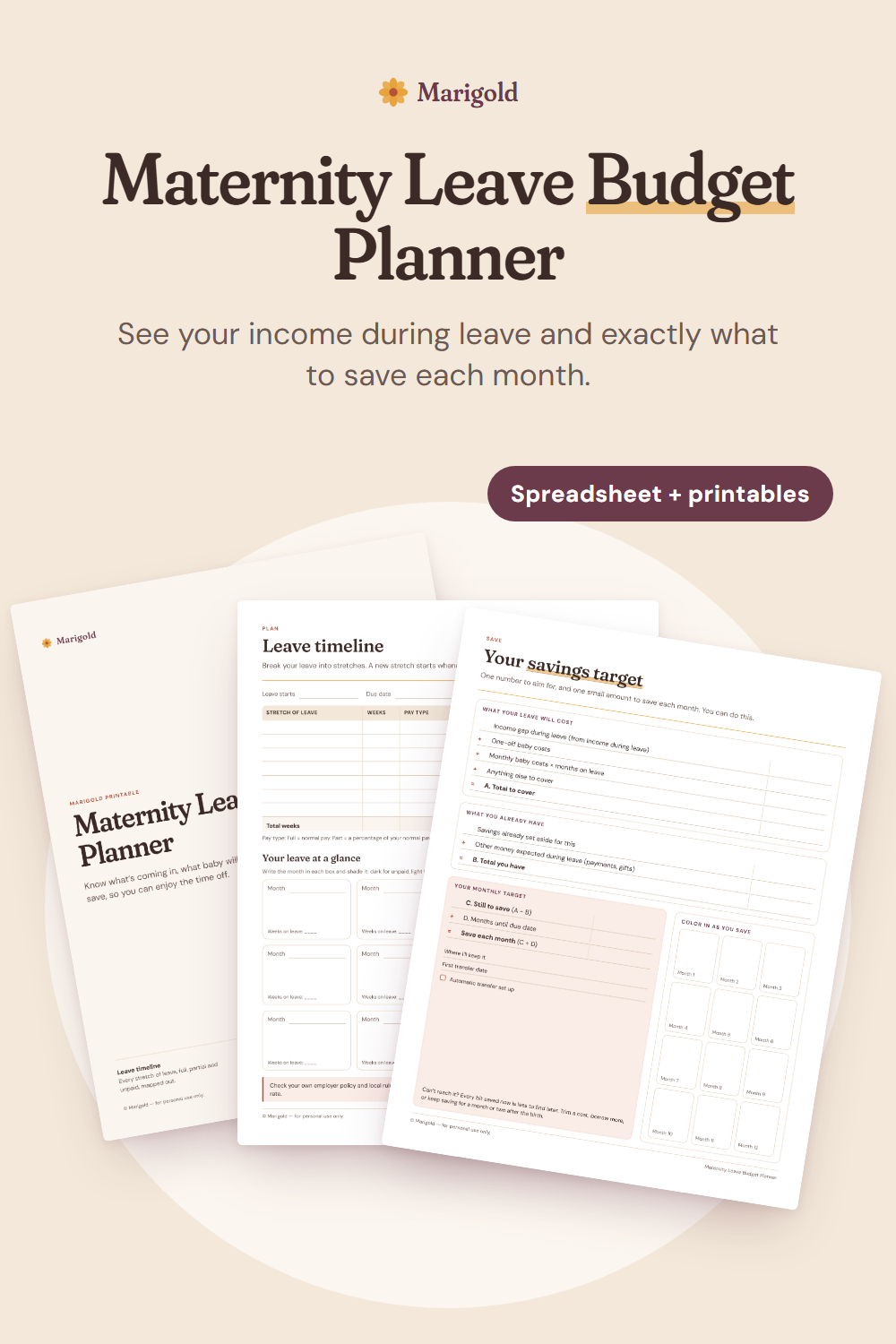
How to budget for maternity leave. Map your leave income month by month, find the gap, and turn it into one amount to save before your due date.
Maternity leave changes your income for a few months, and usually in steps: full pay for a while, then less, then sometimes nothing. The bills don't step down with it. That's why leave can feel financially scary even when you earn a steady salary.
The good news is that it's one of the few money events you can see coming months ahead. If you budget for maternity leave early, the whole thing comes down to one number: how much to set aside each month before the baby arrives. Here's how to find it.
Step 1: Find out what you'll actually be paid
Start with facts, not guesses. What you get on leave depends on your country, your employer and sometimes how long you've worked there, so the only reliable sources are your own.
Ask your HR team or read your contract and staff handbook, and check your government's official information on parental leave pay. Write down:
- How many weeks of leave you can take in total.
- How many of those weeks are at full pay, at partial pay and unpaid.
- What "partial" means as an amount, after tax.
- When you have to give notice, and whether any pay depends on returning to work.
- What happens to benefits such as health cover and retirement contributions while you're off.
If you're self-employed, check what your country offers, if anything, and plan as if any gap in work is unpaid.
Get the answers in writing if you can. Everything else in your plan is built on them.
Step 2: Map your maternity leave income month by month
Now turn those weeks into months. A total for the whole leave hides the hard part, which is that the low months come at the end.
Here's a worked example with made-up, round numbers. Say your normal take-home pay is $3,000 a month and you plan six months of leave: two at full pay, two at half pay and two unpaid.
| Month of leave | Pay | Income |
|---|---|---|
| 1 | Full | $3,000 |
| 2 | Full | $3,000 |
| 3 | Half | $1,500 |
| 4 | Half | $1,500 |
| 5 | Unpaid | $0 |
| 6 | Unpaid | $0 |
| Total | $9,000 |
In six normal months you'd take home $18,000. On leave, in this example, it's $9,000. If you have a partner, do the same for any leave they plan to take, and add their usual income to each month.
Step 3: Work out what you'll spend on leave
Your spending changes too, in both directions.
Some costs often drop while you're home: commuting, lunches out, work clothes. Some rise: heating and electricity if you're home all day, and the baby's running costs like diapers, and formula if you use it. Then there are the one-off costs before the birth, such as a car seat, a crib and a stroller.
Go through your last two or three months of bank statements and build a "leave month" budget: your essentials, adjusted for those changes. Keep the one-off items on a separate list with a price next to each, and mark which you could borrow or buy secondhand. Check current safety guidance before buying a used car seat.
In our example, say a leave month costs $2,600, and the one-off list comes to $900.
Step 4: Find the gap and turn it into a monthly amount
Now the arithmetic:
- Six leave months at $2,600 is $15,600 of spending.
- Leave income is $9,000.
- The gap is $15,600 minus $9,000, which is $6,600.
- Add the $900 of one-off costs: $7,500 to save in total.
Divide by the months you have left. With six months to go, that's $7,500 divided by 6, which is $1,250 a month. With ten months to go, it's $750 a month. Starting early makes the biggest difference of anything on this page.
Treat this as a sinking fund: a pot with one job, kept in a separate account so it doesn't blend into everyday money. Set up a transfer for the day after payday.
Step 5: What to do if the number is too big
Often the first answer is more than you can save. That's useful to know now, while you still have options. You can change any of the inputs:
- Trim the leave budget. Pause subscriptions and extras for the leave months only. A short no-spend challenge before the birth is a good way to find out what you won't miss.
- Shorten the unpaid part. In the example, each unpaid month adds $2,600 to the gap. Going back one month sooner changes the total more than any small cut.
- Reshape the leave. Some employers allow a phased return, using vacation days to extend paid time, or sharing leave with a partner. Ask what's possible where you work.
- Lower the one-off list. Borrow, buy secondhand and wait on anything you won't need in the first weeks.
- Add to the pot. A tax refund, a bonus or money from selling things you no longer use can all go straight in.
Rerun the numbers after each change until the monthly amount is one you can manage. If you already have debts you're struggling to pay, speak to a free non-profit debt advice service before your income drops, not after.
Step 6: Budget for going back to work
Leave ends, and the budget changes again. For many families, the return is harder than the leave itself, because childcare starts.
Before you set a return date, get real prices for the childcare you'd use and build a "back at work" month: your pay, plus commuting and work costs, plus childcare. If you're thinking about returning part-time, run that version too. Check whether your country or employer offers any help with childcare costs, and what you need to do to claim it.
It also helps to keep one extra month of expenses in the pot when you go back. The first month often brings a deposit for childcare and a wait for your first full paycheck.
Common questions
How much money should I save for maternity leave?
Add up what you'll spend during leave plus one-off baby costs, then subtract the income you'll receive while you're off. The difference is what to save. Divide it by the months until your leave starts to get a monthly amount.
How do I budget for unpaid maternity leave?
Treat each unpaid month as a full month of essential spending that has to come from savings. Cut that month's budget to essentials, save the total in a separate account before leave starts, and consider whether one fewer unpaid month would make the plan workable.
When should I start saving for maternity leave?
As soon as you can, ideally as soon as you know you're expecting or planning to be. The total you need stays about the same, so every extra month of saving makes the monthly amount smaller.
This guide is general information, not personal financial advice. Your numbers and circumstances are your own.