How to do a no-spend challenge: rules and a 30-day plan
How to do a no-spend challenge. Set your rules, pick a weekend, a week or 30 days, handle the urge to buy, and decide where the unspent money goes.
A no-spend challenge is a short experiment. For a set time, you pay for what you need and pause everything else. No takeout, no "just browsing," no small treats that quietly add up. Then you look at what happened.
It isn't a punishment and it isn't a new way to live forever. It's a way to see your own habits clearly, and to free up some money for something you care about more. Here's how to do a no-spend challenge that you'll actually finish.
What counts as spending, and what doesn't
The first rule surprises people: you still spend money during a no-spend challenge. Needs are never part of the pause.
Always allowed: rent or mortgage, utilities, groceries, medicine, transport to work, childcare, insurance and every debt payment. If skipping it would cause harm or a late fee, it's a need.
Paused: the extras. Takeout and coffee out, clothes, home decor, beauty, apps, books, hobby supplies, impulse buys at the checkout.
The line between the two is yours to draw. Lunch at work might be an extra for one person and a need for another. What matters is that you draw the line before you start, not in the shop.
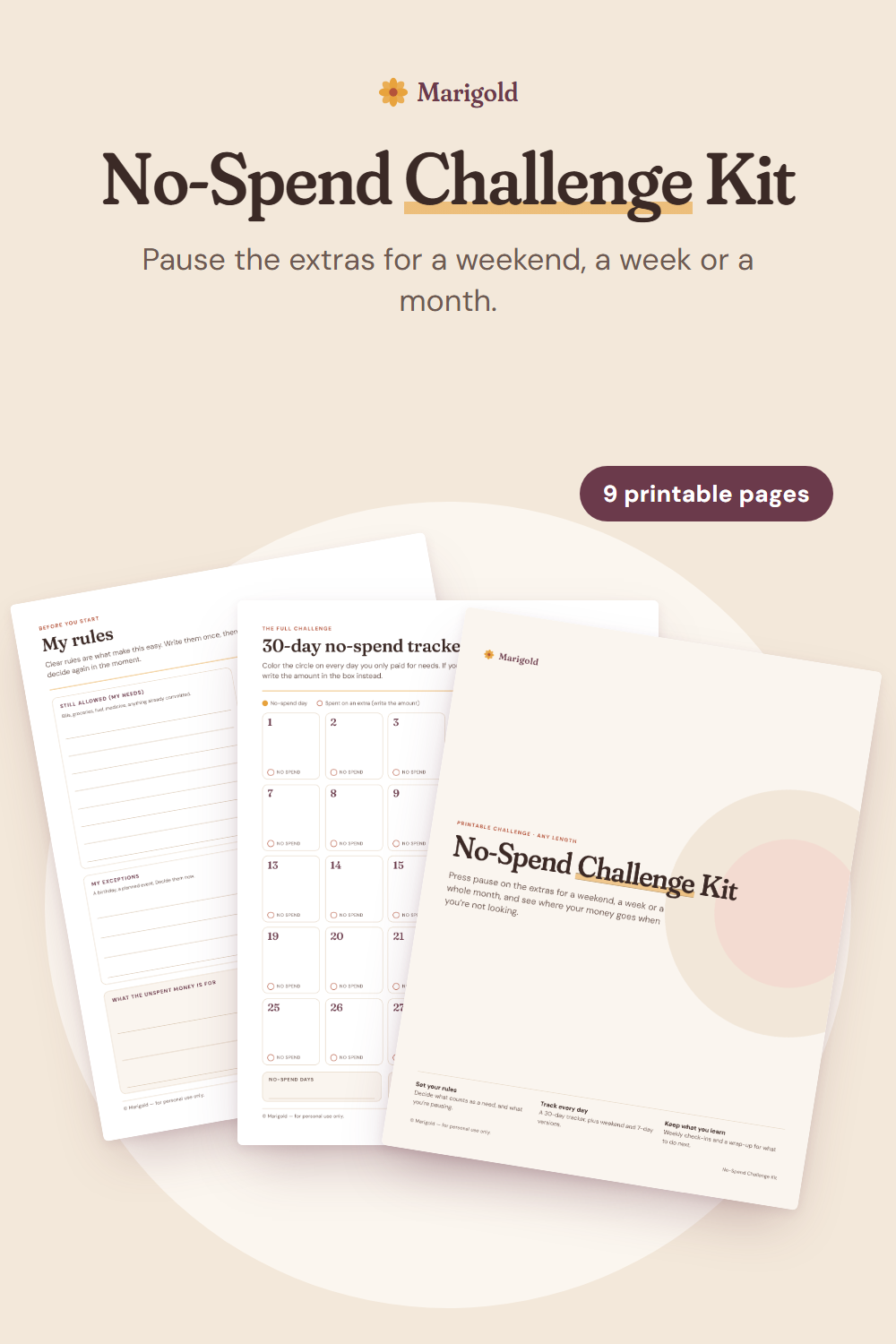
Step 1: Write your no-spend challenge rules
Rules decided in advance are easy to follow. Rules made up on the spot always lean toward buying the thing. So write three short lists:
- My needs. Everything you'll keep paying for.
- My extras. Everything that's paused. Be specific: "takeout" is clearer than "eating less out."
- My exceptions. Things that would otherwise be extras but are allowed this time, like a birthday gift you've already promised or a ticket you booked last month.
Keep the exceptions short and name them now. An exception you planned is part of the challenge. An exception you invent on day nine is just spending.
Step 2: Pick a length you can finish
Longer isn't better. Finished is better.
| Length | Good for | What to expect |
|---|---|---|
| A weekend | Your first try | Easy to plan around, and it shows you how often you spend out of habit |
| 7 days | Building the habit | Long enough to hit a hard day and get through it |
| 30 days | A real reset | The first week is the hardest, the middle gets easier, and you learn the most |
If you've never done one, start with a weekend or a week. You can always go again. A 30-day challenge you drop on day six teaches you less than a week you complete.
Pick your start date with care, too. Look at the calendar for birthdays, trips and events, and either choose a quieter stretch or add those to your exceptions.
Step 3: Decide where the unspent money goes
This is the step most people skip, and it's the one that makes the challenge worth doing. Money you didn't spend has a way of drifting into next week's spending unless it has a job.
Name the job before you start. A starter emergency fund, an extra debt payment, or a known cost that's coming, like the holidays or car repairs. If you have a few of those coming, our guide to sinking funds shows how to split money between them.
Then make it real. Each time you skip something you'd normally buy, move that amount to savings the same day, or move a total at the end of each week. Seeing the balance grow is what keeps you going in week three.
Step 4: Keep an urge log
You will want to buy things. That's not failing. It's the whole point of the experiment.
When the urge arrives, write down what it is and what it costs before you do anything else. Then wait. Most urges pass within a day, and many pass within the hour.
Here's what a week's log might look like, with made-up numbers:
| Day | What I wanted | Price |
|---|---|---|
| Monday | Coffee on the way to work | $5 |
| Wednesday | Takeout after a long day | $28 |
| Friday | A top I saw online | $35 |
| Sunday | A new app subscription | $12 |
| Total not spent | $80 |
That $80 is real money you still have. The log also shows you when you spend: tired, bored, scrolling, or on the way somewhere. That pattern is more useful than the total, because it tells you what to change after the challenge ends.
If something is still on your mind when the challenge is over, you can buy it then. You'll be choosing it on purpose, which is different.
Step 5: Plan for the hard moments
A no-spend challenge leaves gaps where spending used to be. Fill them on purpose, or the old habit will.
- Make a list of free things to do. A walk, the library, a movie you already own, cooking something from the back of the cupboard, a friend over for coffee at home.
- Remove the easy routes. Unsubscribe from sale emails, log out of shopping apps, and delete saved card details for the month.
- Tell people. "I'm doing a no-spend month, want to come over instead?" is a normal thing to say, and friends often join in.
- Plan your meals. Most slips are food. Knowing what's for dinner removes the biggest one.
What to do if you slip
You bought something. The challenge isn't over.
Write it in your log, note what was going on, and carry on with the next day. One slip in thirty days is twenty-nine days of doing what you set out to do. Starting again from day one is optional, and usually not helpful.
If you slip in the same way several times, that's information. Either the rule was too strict to be realistic, or that one habit needs its own plan. Adjust the rule and keep going.
When you finish, take ten minutes to look back. What didn't you miss at all? What did you miss a lot? Cancel or cut the first group, and put the second group back into your budget on purpose. If you want a plan for the money from here, budgeting by paycheck is a good next step.
Common questions
What are the rules of a no-spend challenge?
You keep paying for needs (housing, bills, groceries, medicine, transport and debt payments) and pause the extras for a set time. You write down your own needs, extras and any exceptions before you start, so you aren't deciding in the moment.
Can you buy groceries during a no-spend challenge?
Yes. Groceries are a need and are always allowed. Many people use the challenge to cook from what they already have and to skip takeout, but you should never cut food, medicine or bills to make a challenge work.
How long should a no-spend challenge be?
A weekend or seven days is best for a first try, because you're likely to finish it. Thirty days is a fuller reset once you know your rules work. A short challenge you complete is more useful than a long one you drop.
This guide is general information, not personal financial advice. Your numbers and circumstances are your own.