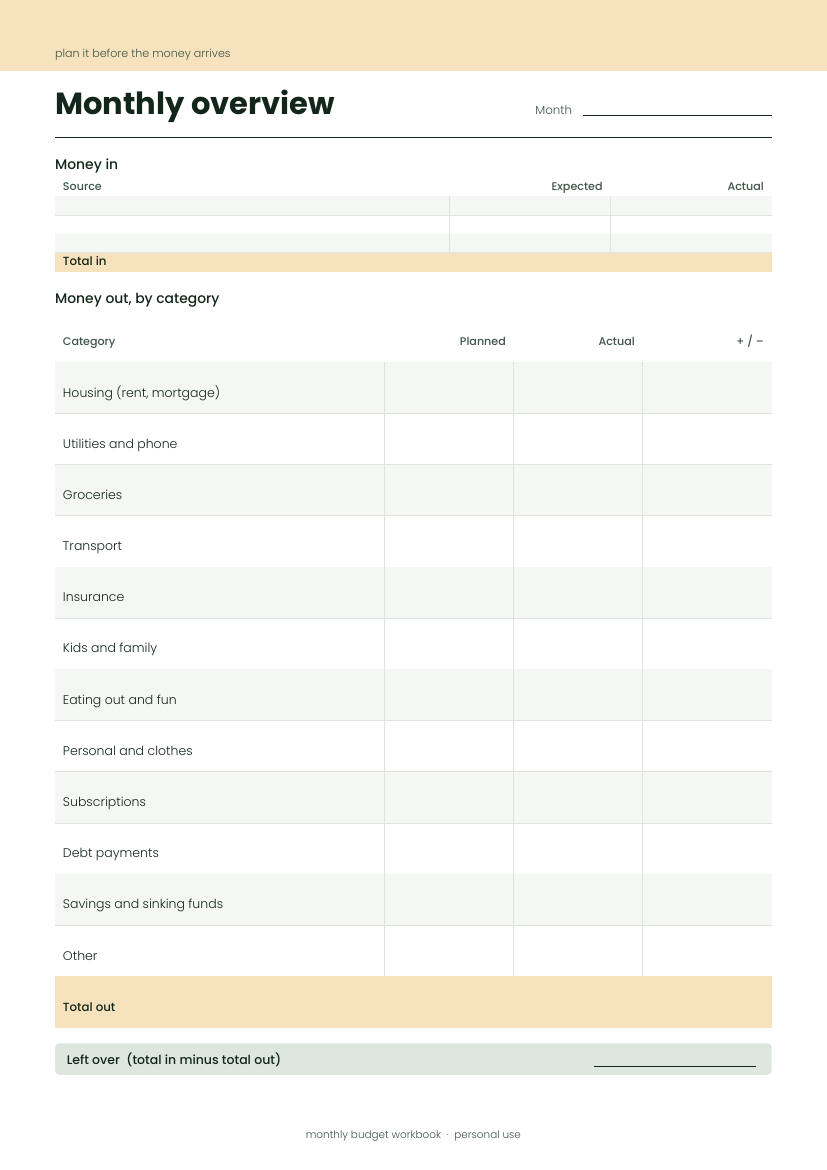
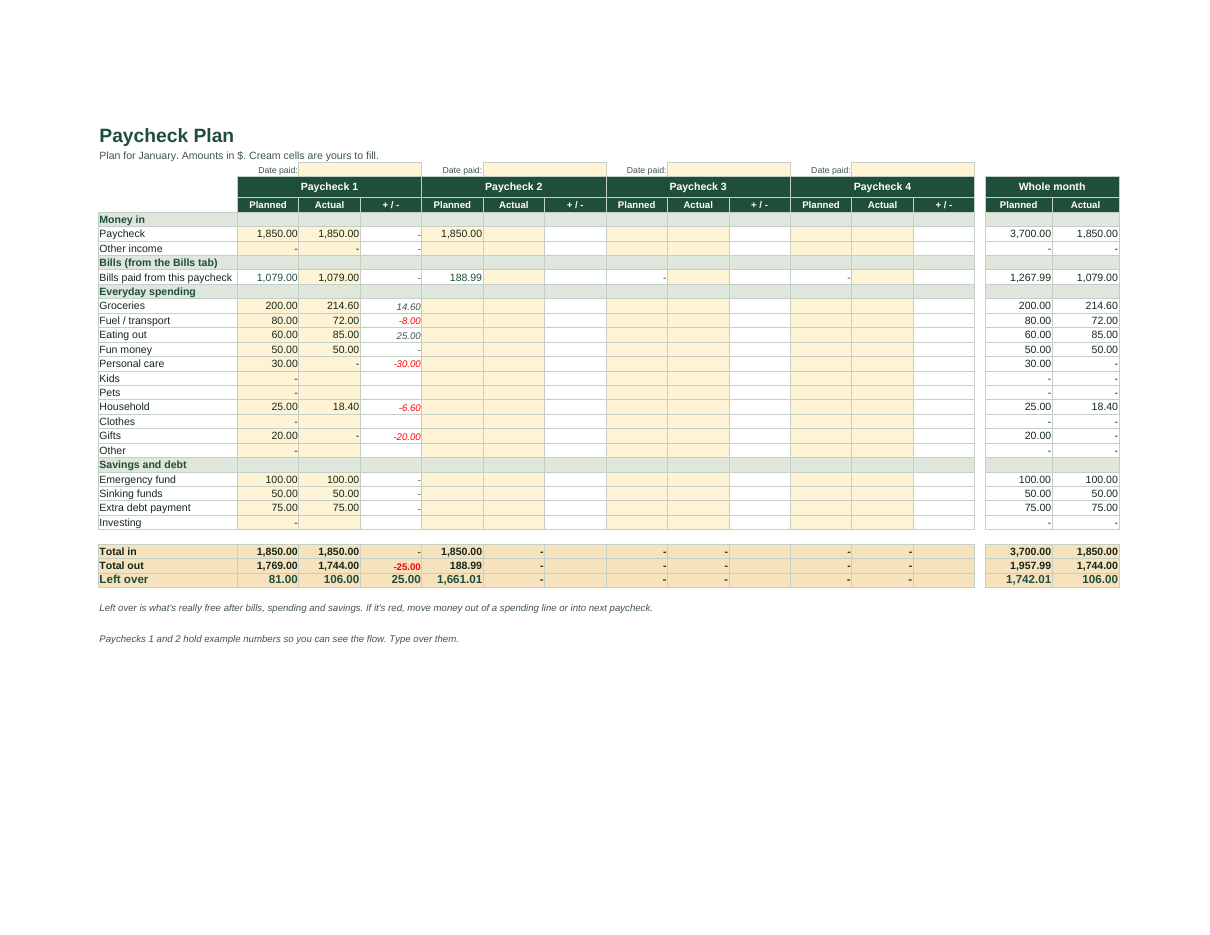
Zero-based budgeting explained, with a worked example
What zero-based budgeting is, how to set one up step by step, and a full worked example where every dollar of take-home pay is given a job.
Zero-based budgeting sounds like you're meant to end the month with nothing in your account. You're not. The "zero" is on paper: income minus everything you plan for it equals zero, because every dollar has been given a job before the month starts.
That small rule changes how a budget feels. Money that has no job tends to drift away on small things. Money that has a job, even if the job is "fun" or "savings," usually stays where you put it. This guide explains the method, walks through a full example and covers the months where it doesn't add up.
What zero-based budgeting means
In a zero-based budget, you start with your take-home pay for the month and assign all of it, line by line, until there's nothing left to assign.
The formula is simple:
Take-home pay − bills − spending − savings − debt payments − fun = 0
If the answer is above zero, you have money without a plan, so you give it one. If it's below zero, you've planned to spend money you don't have, so something has to shrink. You keep adjusting until it lands on zero exactly.
It's called "zero-based" because each month starts from nothing. You don't copy last month's numbers and hope. You build the plan again, which takes less time than it sounds once you've done it twice.
How it's different from other budgets
Most budgets look at the past. You track what you spent, compare it to a rough target, and feel either fine or guilty. Zero-based budgeting looks forward. It decides the spending before it happens.
It's also stricter than a percentage rule, like putting a set share toward needs, wants and savings. Percentages are a useful starting point, but they leave the details fuzzy. A zero-based budget names every line, so you can see exactly where the money is going and change one line without guessing.
If you're brand new to budgeting, our guide on how to start budgeting uses four broad groups. Zero-based budgeting is the next step: the same idea, with more detail.
Step 1: Start with one month's take-home pay
Write down what will actually land in your account this month, after tax and deductions. Not your salary, and not what you hope to earn.
If your income changes, use the lowest month you'd realistically expect. If you're paid every two weeks, count only the paychecks that arrive this month. A plan built on a cautious number still works when more money comes in. A plan built on a hopeful one breaks.
Step 2: List every line the money has to cover
Go through last month's bank statement and write a line for each kind of cost:
- Bills: rent or mortgage, utilities, phone, insurance, subscriptions, minimum debt payments.
- Everyday spending: groceries, fuel or transport, household things.
- Savings: an emergency fund, plus sinking funds for costs you know are coming, like car repairs or gifts.
- Extra debt payments: anything above the minimum.
- Yours: money to spend on anything, without explaining it.
Don't skip the last line. A budget with no fun in it rarely lasts the month. For irregular costs, our guide to sinking funds shows how to turn them into a small monthly line.
Step 3: Give every dollar a job
Now put an amount next to each line, in this order: bills first, then everyday spending, then savings and debt, then fun. Add it up and compare it to your take-home pay.
A worked example
Here's a made-up month with take-home pay of 3,200. The first pass looks like this:
| Line | First pass | Final |
|---|---|---|
| Rent | 1,100 | 1,100 |
| Utilities and phone | 180 | 180 |
| Insurance | 120 | 120 |
| Groceries | 450 | 450 |
| Transport | 200 | 200 |
| Minimum debt payments | 150 | 150 |
| Extra debt payment | 100 | 100 |
| Emergency fund | 200 | 400 |
| Sinking funds | 150 | 150 |
| Household and personal | 150 | 150 |
| Fun | 200 | 200 |
| Total | 3,000 | 3,200 |
The first pass adds up to 3,000, which leaves 200 with no job. In a looser budget, that 200 would probably disappear without anyone noticing. Here, it gets assigned: in this example it goes to the emergency fund, which brings that line to 400. Now 3,200 − 3,200 = 0, and the budget is done.
It could just as easily have gone to the extra debt payment or a sinking fund. The method doesn't choose for you. It just makes sure you choose.
When the numbers don't reach zero
Sometimes the first pass comes out over your income, not under it. Say it totals 3,350 against 3,200: you're 150 over.
Start with the lines you control: fun, household, groceries, extra debt payments and savings. In this case, taking 50 off fun, 50 off groceries and 50 off the extra debt payment closes the gap: 3,350 − 150 = 3,200. Small cuts across a few lines are usually easier to keep than one big cut.
If you've trimmed everything you can and the bills alone are more than your income, the problem isn't the budget. It's a gap between income and fixed costs, and it needs a bigger change, like a cheaper bill, more income, or help with debt. If you can't keep up with debt payments, a free non-profit debt advice service in your country can help you look at the options.
Keeping it going through the month
A zero-based budget is a plan, not a prediction. Things will move. When groceries run over, take the difference from another line, like fun or household, so the total still matches your income. That's the only rule: if one line goes up, another goes down.
At the end of the month, compare what you planned with what happened, and use that to set next month's numbers. Most people find the second month's plan is far more accurate than the first. If you're paid weekly or every two weeks, you can build the same plan per paycheck instead; our guide on budgeting by paycheck shows how.
Common questions
Does zero-based budgeting mean having zero dollars in the bank?
No. The zero is on paper. It means every dollar of income has been assigned to a line, including savings. Your account can still hold money, because savings and sinking funds are part of the plan.
Is zero-based budgeting good for beginners?
It can be, but it asks for more detail than a simple four-group budget. Many people start with broad groups for a month or two, then move to zero-based budgeting once they know their real numbers.
What do I do with leftover money in a zero-based budget?
Give it a job before the month starts. Common choices are an emergency fund, a sinking fund for a known cost, or an extra debt payment. If money is left at the end of the month, move it to one of those lines.
This guide is general information, not personal financial advice. Your numbers and circumstances are your own.