The 52-week savings challenge, and three easier versions
How the 52-week savings challenge works, what it adds up to, why most people stall near the end, and three easier versions you are more likely to finish.
The 52-week savings challenge is one of the simplest ways to start saving money. You save $1 in the first week, $2 in the second, $3 in the third, and keep adding a dollar each week for a year. In week 52 you save $52, and you finish with $1,378.
It's popular because the start is so easy. Anyone can find a dollar. The catch is the other end of the year, and that's where most people drop out. Here's how the challenge works, where it gets hard, and three easier versions that reach the same total.
How the 52-week savings challenge works
The rule fits on one line: each week, save the same number of dollars as the week number.
Week 1 is $1. Week 10 is $10. Week 30 is $30. You don't skip ahead and you don't go back. If you add up every week from 1 to 52, you get $1,378.
You can start in any week of the year. January is traditional, but the week you're reading this works just as well. Week 1 is simply the week you begin.
If you use pounds or euros, the numbers stay the same and only the symbol changes.
What the year actually looks like
The total sounds gentle. The shape of it is not. Here's the same $1,378 split into quarters:
| Weeks | You save in this stretch | Running total |
|---|---|---|
| 1 to 13 | $91 | $91 |
| 14 to 26 | $260 | $351 |
| 27 to 39 | $429 | $780 |
| 40 to 52 | $598 | $1,378 |
Halfway through the year, you've saved about a quarter of the money. The last thirteen weeks ask for more than six times what the first thirteen did.
Why people stall near the end
The classic version saves the hardest part for last. The final four weeks ask for $49, $50, $51 and $52. That's $202 in a single month.
If you started in January, that month is December, when gifts, travel and food are already pulling at your budget. The challenge gets most expensive in the same weeks everything else does.
The early weeks have their own problem. A dollar or two feels too small to bother moving, so it's easy to skip a week and tell yourself you'll catch up. By the time the amounts feel real, you're several weeks behind.
None of this means the challenge is bad. It means the standard order doesn't suit everyone. The total is what matters, and there's more than one way to reach it.
Easier version 1: Run it in reverse
Start with $52 in week 1 and go down by a dollar each week. Week 52 costs you $1.
The total is the same $1,378. The difference is that the biggest amounts come when your motivation is highest, and the challenge gets lighter as the year goes on. If you begin in January, December asks for $10 across four weeks instead of $202.
The reverse version suits you if you can find about $50 a week right now. If that first month looks too steep, try one of the next two instead.
Easier version 2: Pick any amount each week
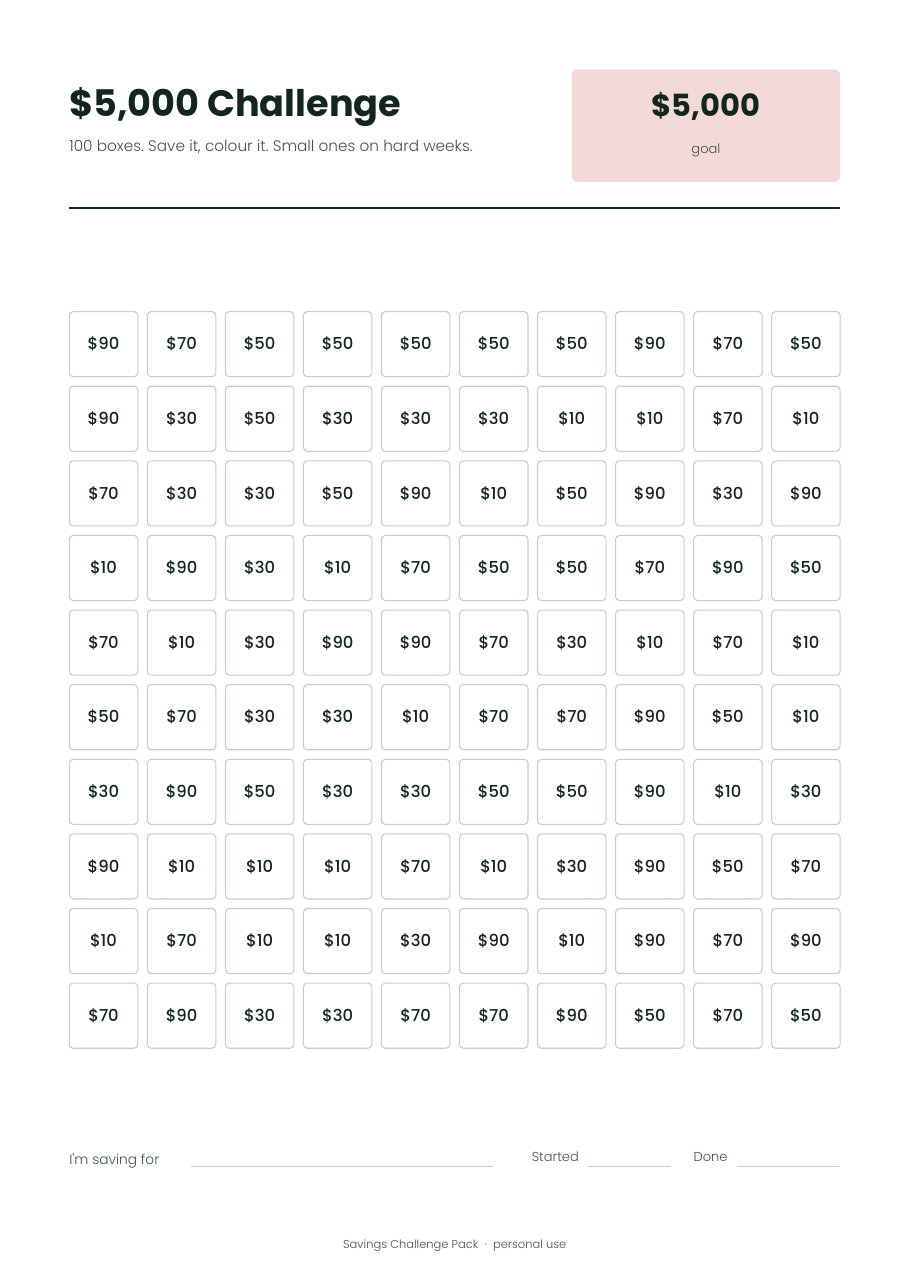
Print or draw a chart with the numbers 1 to 52. Each week, choose any number that's still open, save that many dollars, and cross it off.
A good week, when you worked extra hours or spent less than planned, is a week for a number in the forties. A tight week is a week for a 3. After 52 weeks every number is crossed off and you have the same $1,378.
This is the version that works best with a tracker you color in, because you can see at a glance which amounts are left.
One tip: don't use up all the small numbers first. If you cross off 1 to 20 in the first twenty weeks, you've rebuilt the classic challenge, hard ending included. Try to take one large number each month.
Easier version 3: Save the same amount every week
Divide the total by 52 and you get $26.50. Save $26.50 every week for a year and you finish with exactly $1,378.
This version has no surprises. You can set it up as an automatic transfer once and never think about it again. It's the least exciting and the most likely to be finished.
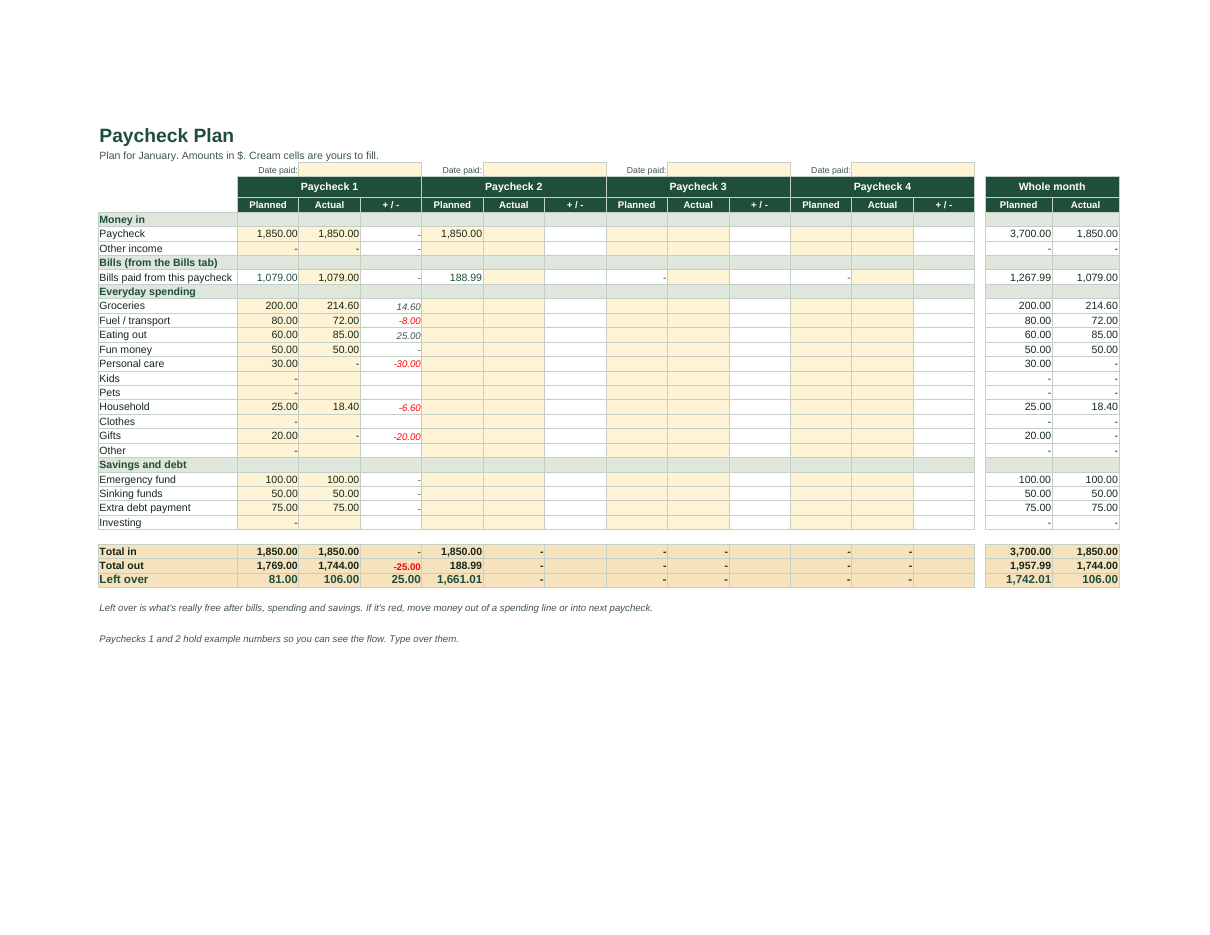
If you're paid every two weeks, match it to your paydays instead: $53 from each of your 26 paychecks is the same $1,378. Treat it like a bill that comes out first. Our guide to budgeting by paycheck shows how to give it a fixed place in each payday's plan.
If $1,378 is too much right now
Cut every number in half. Save 50 cents in week 1, $1 in week 2, and so on up to $26 in week 52. The total is $689.
Half a challenge you finish is worth more than a full one you drop in October. All three easier versions work at half size too: reverse it from $26, cross off half-dollar amounts in any order, or save a flat $13.25 a week.
If you already have debts that charge high interest, it's usually worth keeping this small while you pay those down. A few hundred dollars of buffer stops each surprise from going back on a card.
Make it stick
- Give the money a job. "Savings" is vague. A starter emergency fund, next year's holidays or a car repair fund is something you'll protect. If you have several of those in mind, read about sinking funds.
- Keep it apart. Use a separate savings account or pot, so the money isn't sitting next to your spending money.
- Pick a day. Move the money on the same day each week, ideally the day you're paid.
- Put the tracker where you'll see it. The fridge, the inside of a cupboard door, the front of your planner. Seeing the boxes fill in is the reward.
- Missed a week? Save it alongside next week's amount, or add a week to the end. Don't start over.
Common questions
How much do you save with the 52-week savings challenge?
You save $1,378 in a year. That's the sum of every amount from $1 in week 1 to $52 in week 52. The half-size version, which goes up by 50 cents a week, comes to $689.
Can I start the 52-week savings challenge in the middle of the year?
Yes. Week 1 is whichever week you begin, and the challenge ends 52 weeks later. Starting mid-year can even help, because the largest weeks then fall outside the December holidays.
What is the reverse 52-week savings challenge?
It's the same challenge run backward. You save $52 in the first week and one dollar less each week, ending with $1 in week 52. The total is still $1,378, but the hardest weeks come first, while your motivation is fresh.
This guide is general information, not personal financial advice. Your numbers and circumstances are your own.